




Volkswagen Tiguan vs. Honda CR-V: Breaking Down the Smart SUV Choice for 2025
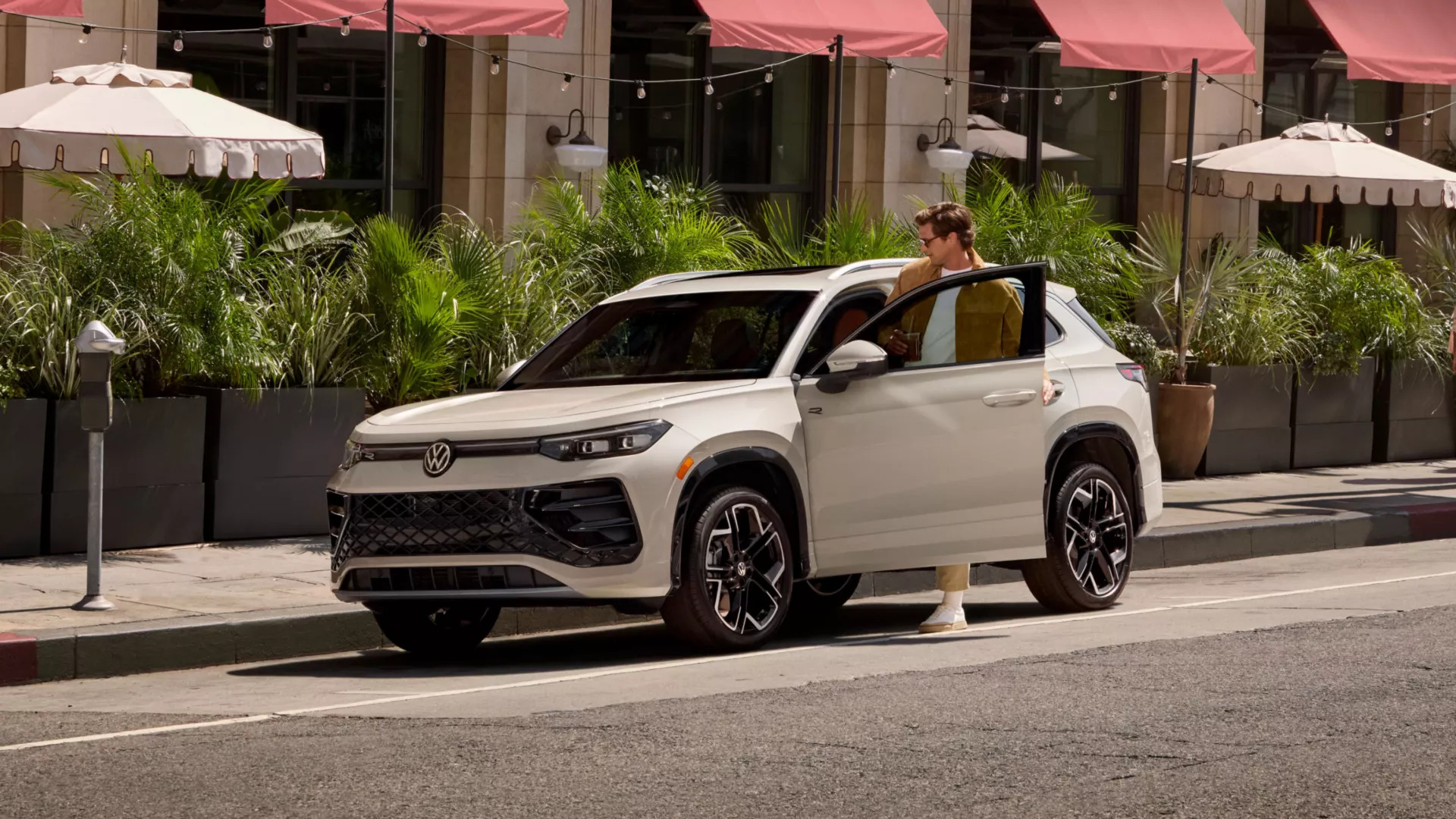
Introduction: Two Compacts, One Crucial Decision
Compact SUVs continue to dominate the market and for good reason. They
blend sedan-like drivability with added cargo space, safety, and efficiency.
Two of the most talked-about options in this space are the 2025 Volkswagen Tiguan and the 2025 Honda CR-V.
Each offers a solid reputation, updated design, and a wide range of tech
and driver-assist features. So, how do they compare in real-world areas like
powertrain performance, safety technologies, cargo space, and warranty
coverage?
In this data-driven comparison from Stone Mountain Volkswagen, let’s examine the numbers, specs, and strengths of both models.
Powertrain and Performance: Turbocharged or Hybrid Efficiency?
Volkswagen Tiguan
The 2025 Tiguan has a 2.0L turbocharged inline-4 engine, producing around 184 horsepower and 221 lb-ft of torque. It’s paired with an 8-speed automatic transmission and comes standard with front-wheel drive (FWD), with optional 4MOTION® all-wheel drive for enhanced road grip and weather capability.
This turbocharged powerplant provides consistent mid-range torque and
balanced responsiveness for highway merging and passing.
Honda CR-V
The 2025 CR-V offers two powertrain configurations:
-
A 1.5L turbocharged engine with 190 hp and 179 lb-ft of torque (paired with a CVT)
-
A hybrid variant
with a 2.0L engine and dual electric motors producing a combined 204 horsepower
While the hybrid offers increased efficiency, the Tiguan delivers a more
refined and engaging drive due to its traditional automatic transmission and
higher torque output at lower RPMs.
Verdict
The Tiguan’s turbo engine provides more substantial torque for acceleration,
while the CR-V hybrid wins in fuel economy.
Fuel Efficiency: Comparing MPGs
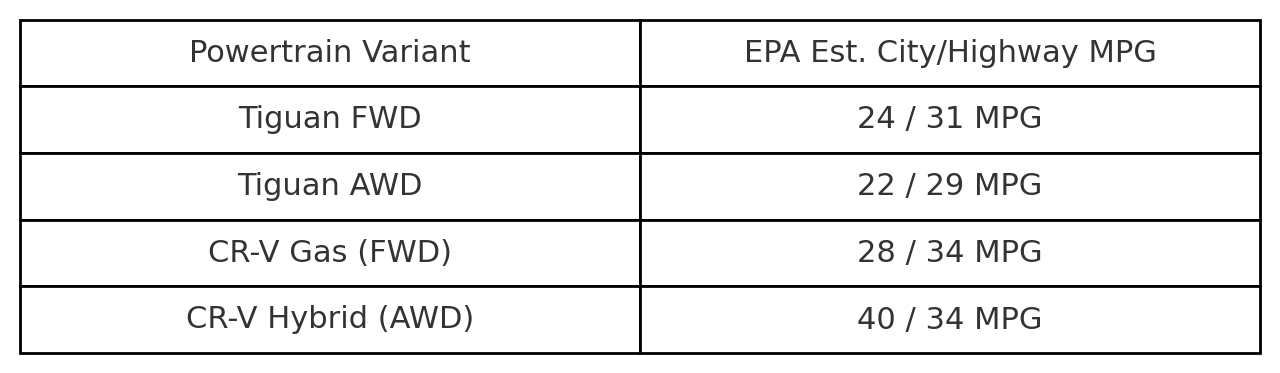
While the CR-V leads overall MPG, especially in hybrid form, the Tiguan
provides respectable efficiency considering its turbocharged performance and
AWD availability.
Interior Space and Seating
Volkswagen Tiguan
A standout feature of the Tiguan is its optional third-row seat
(on FWD models), giving it a rare edge in passenger capacity for the compact
SUV class. This makes it capable of seating up to seven passengers, although the third row is best suited for children or short trips.
Interior materials are solid, and the layout is ergonomic, with an emphasis
on visibility and driver control.
Honda CR-V
The CR-V is strictly a five-passenger SUV, but it excels in second-row legroom and cargo configuration. It’s known
for a spacious cabin with a more open feel.
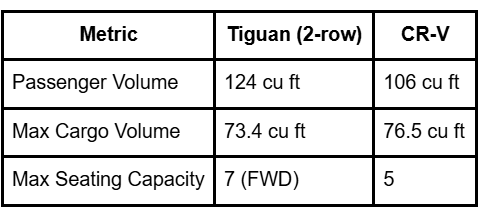
Interior Dimensions Comparison (Approx.):
Verdict
If you need third-row versatility, the Tiguan wins. The CR-V has a slight
edge if rear cargo space is the priority.
Technology and Infotainment Features
Both vehicles will be well-equipped by 2025, but interface design and
system layout differences will emerge.
Volkswagen Tiguan
-
8-inch Digital Cockpit (standard)
-
Optional Digital Cockpit Pro with full-screen nav and customization
-
8-inch or available 10.25-inch touchscreen
-
Apple CarPlay® and Android Auto™ (wireless available)
-
Available Fender® premium audio system
-
Touch-sensitive HVAC controls and USB-C charging ports
Honda CR-V
-
7-inch touchscreen standard; 9-inch on upper trims
-
Wired Apple CarPlay® and Android Auto™ standard
-
Wireless connectivity on higher trims
-
Basic digital instrument cluster
-
Bose® 12-speaker system on Touring trims
Verdict
Tiguan offers a more refined and configurable digital driving experience,
while CR-V delivers a straightforward layout with consistent tech in upper
trims.
Driver Assistance and Safety Technology
Both models include standard advanced safety features, but the
implementation varies.
Volkswagen IQ.DRIVE (Standard on most trims)
-
Forward Collision Warning with Automatic Braking
-
Blind Spot Monitoring
-
Lane Assist
-
Adaptive Cruise Control w/ Stop & Go
-
Travel Assist (semi-autonomous driving support)
Honda Sensing® Suite (Standard)
-
Collision Mitigation Braking System™
-
Road Departure Mitigation
-
Lane Keeping Assist System
-
Adaptive Cruise Control w/ Low-Speed Follow
-
Traffic Sign Recognition
Verdict
Both offer competitive safety suites. Tiguan’s Travel Assist
feature adds value with hands-on semi-autonomous lane centering and adaptive
cruise, integrated in a smoother control package.
Warranty and Maintenance Coverage
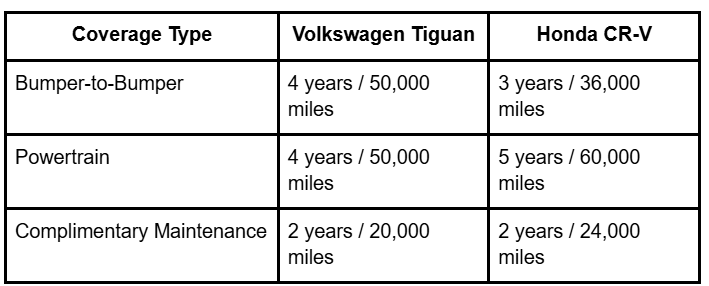
Tiguan’s longer bumper-to-bumper warranty offers broader initial coverage,
while Honda’s powertrain coverage extends slightly longer.
Model Trims and Variety
Tiguan Trim Highlights
-
S – Standard safety and digital cockpit
-
SE – Wireless phone charging, IQ.DRIVE
-
SE R-Line Black – Black styling accents, sunroof
-
SEL R-Line – Top-tier tech, leather seating, and 4MOTION®
CR-V Trim Highlights
-
LX – Basic safety features
-
EX – Apple CarPlay®, power driver seat
-
EX-L – Leather, wireless charging
-
Sport Touring (Hybrid) – Bose audio, AWD, and larger touchscreen
Which SUV Is Right for You?
Conclusion: A Comparison Based on Substance
Choosing between the Volkswagen Tiguan and the Honda CR-V
isn’t about good vs. bad; it’s about matching your needs with each SUV’s
strengths.
-
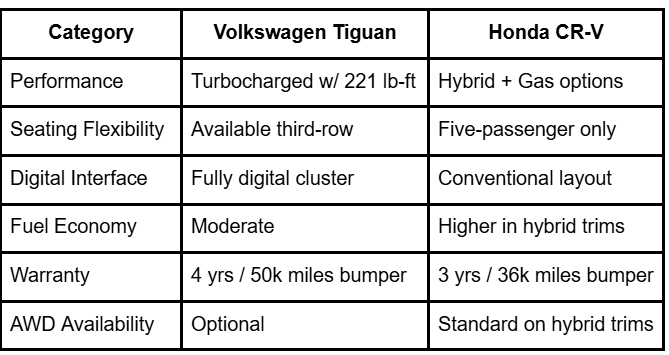
The Tiguan stands out if you value a more refined digital experience, the option for a third row, and a more extended base warranty.
-
The CR-V makes a compelling case if fuel economy and a hybrid powertrain
are top priorities, and you’re okay with a five-passenger layout.
We invite you to experience the 2025 Tiguan in person at Stone Mountain Volkswagen. Our team is here to help you make the right decision based on
performance, practicality, and value.
0 comment(s) so far on Volkswagen Tiguan vs. Honda CR-V: Breaking Down the Smart SUV Choice for 2025